


Top quark physics
Associated production of the top quark pair and the Z boson (shortly ttZ)
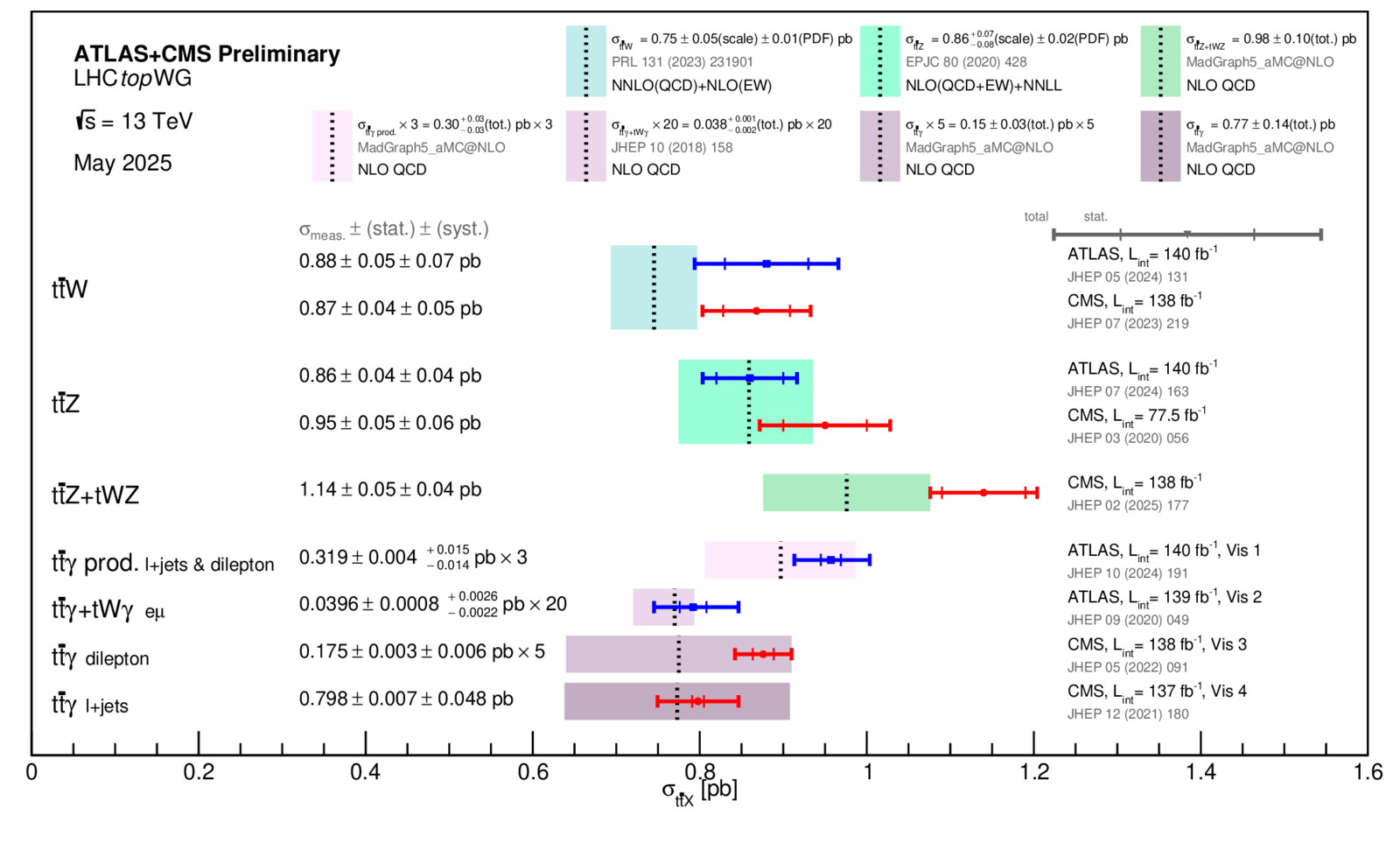
Associated production of the top-quark pair and the Z boson (so called ttZ) is a rare process with the cross-section about 1000 times lower compared to the cross-section of top quark pair production. The ttZ process is important for testing of the Standard Model, it is also an important background for some other measurements and searches, and it also provides opportunities to search for a new physics. This process allows us to study the coupling constant of the Z boson to the top-quark. It is also suitable for searching for a new physics because of its massive final state, which can be done, for example, via so called Effective Field Theory (EFT). Depending on the decay channels of both top quark and Z boson, different particles can be found in the final state. The final states differ by number of leptons, which can be from 0 to 4. The past and present ttZ measurements use decay channels with 2, 3 and 4 leptons.
Our group has worked on three already published measurements of the ttZ cross section and is currently working on a next one. We were focusing on inclusive cross section measurements in two- and four-lepton decay channels, as well as measurement of the differential cross section in three- and four-lepton channels:
- Phys. Rev. D 99 (2019) 072009 (arXiv:1901.03584),
- Eur. Phys. J. C 81 (2021) 737 (arXiv:2103.12603),
- conf. note ATLAS-CONF-2023-065
- JHEP 07 (2024) 163, (arXiv:2312.04450)
In the recent measurement, we have measured the total ttZ cross-section with the precision of 6.2%, which is significantly more precise than the latest theory prediction (10%).
Currently we are working on the measurement of the ttZ cross section in so called boosted topology, where decay products of the hadronically decaying top-quark form a large jet.
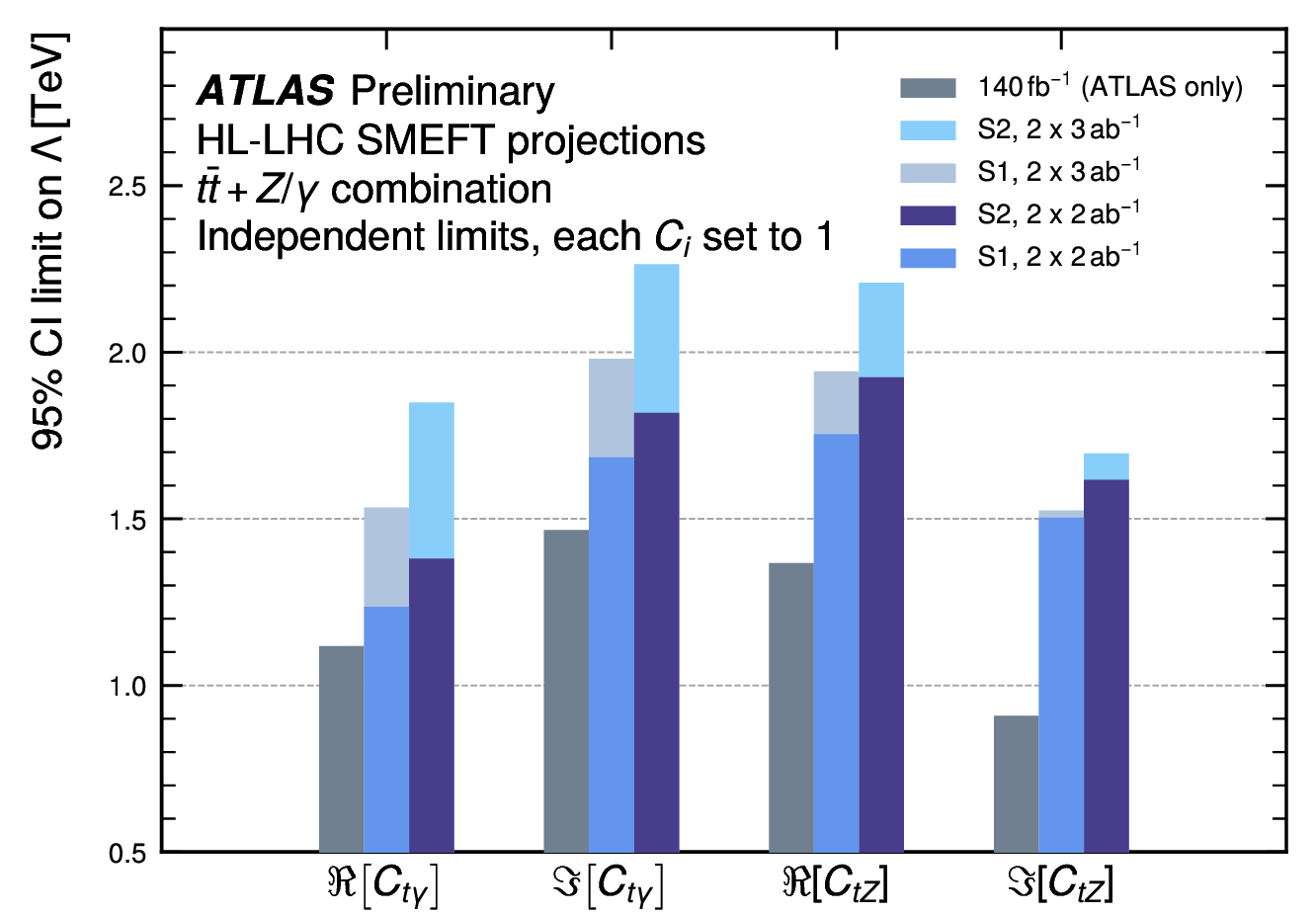
As part of the planning for the High Luminosity LHC (HL-LHC), we have been involved in estimating the expected uncertainty in measurements of Wilson coefficient (in the effective field theory, EFT) for the expected HL-LHC dataset of size 2 or 3 inverse atobarn. As part of this estimate, we scaled Monte Carlo to the expected luminosity and tested two scenarios for systematic uncertainties. In the conservative scenario, we left the relative systematic uncertainties unchanged; in the more realistic scenario, we scaled the experimental uncertainties inversely proportional to the square root of the luminosity ratio, and we reduced the theoretical systematic uncertainties by factor of 2. The estimate shows that compared to the Run 2 LHC dataset, we should be able to increase the limits on the EFT cut-off scale by about 60-100%, depending on the coefficient, the dataset used, and the uncertainty scenario.
More information can be found in public note:
Charge asymmetry in top-quark pair production
Zoznam publikácií:
- Meranie energetickej asymetrie v eventoch s top-kvarkovým párom a dodatočným jetom:
- Meranie nábojovej asymetrie v top-kvarkovej párovej produkcii:
- konf. note ATLAS-CONF-2019-026,
- JHEP 08 (2023) 077 (arXiv:2208.12095)
Calibration of jet energy scale using top-quark pair production events
Identification of boosted top quarks at the LHC
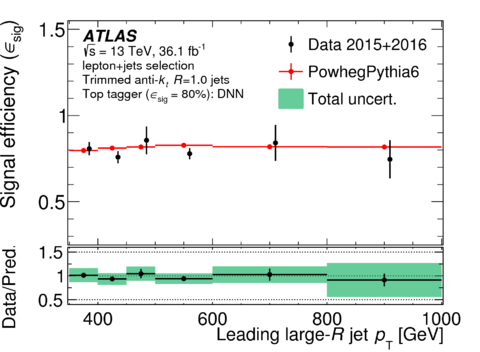
With increasing energy of proton collisions, one may observe higher rate of top quark production with very high energy. As a consequence of this very high energy, according to special theory of relativity the top quark decay products are closer to each other in the direction of the movement. This fact presents a challenge especially for the so-called hadronic decay of top quark (into a b-quark and a pair of quark-antiquark), which manifests itself as three jets in the detector (jet = stream of particles concentrated in a given direction). For low energies, the standard approach was to reconstruct each jet individually, since these were clearly separated in space. This approach fails for boosted top quarks due to the merging of the individual jets together.
A solution to this problem is the use of large jets - the streams of particles from the three jets are collected together in a form of a single big jet, whose substructure is studied. Using this substructure, one may distinguish boosted top quarks from other particles.
For a successful and efficient identification of top quarks at the LHC at the energy of 13 or 14 TeV these techniques will play a very important role.
In our team, we were involved in study of performance of identification algorithms for hadronically decaying top quarks and W bosons published in
The top quark decay width
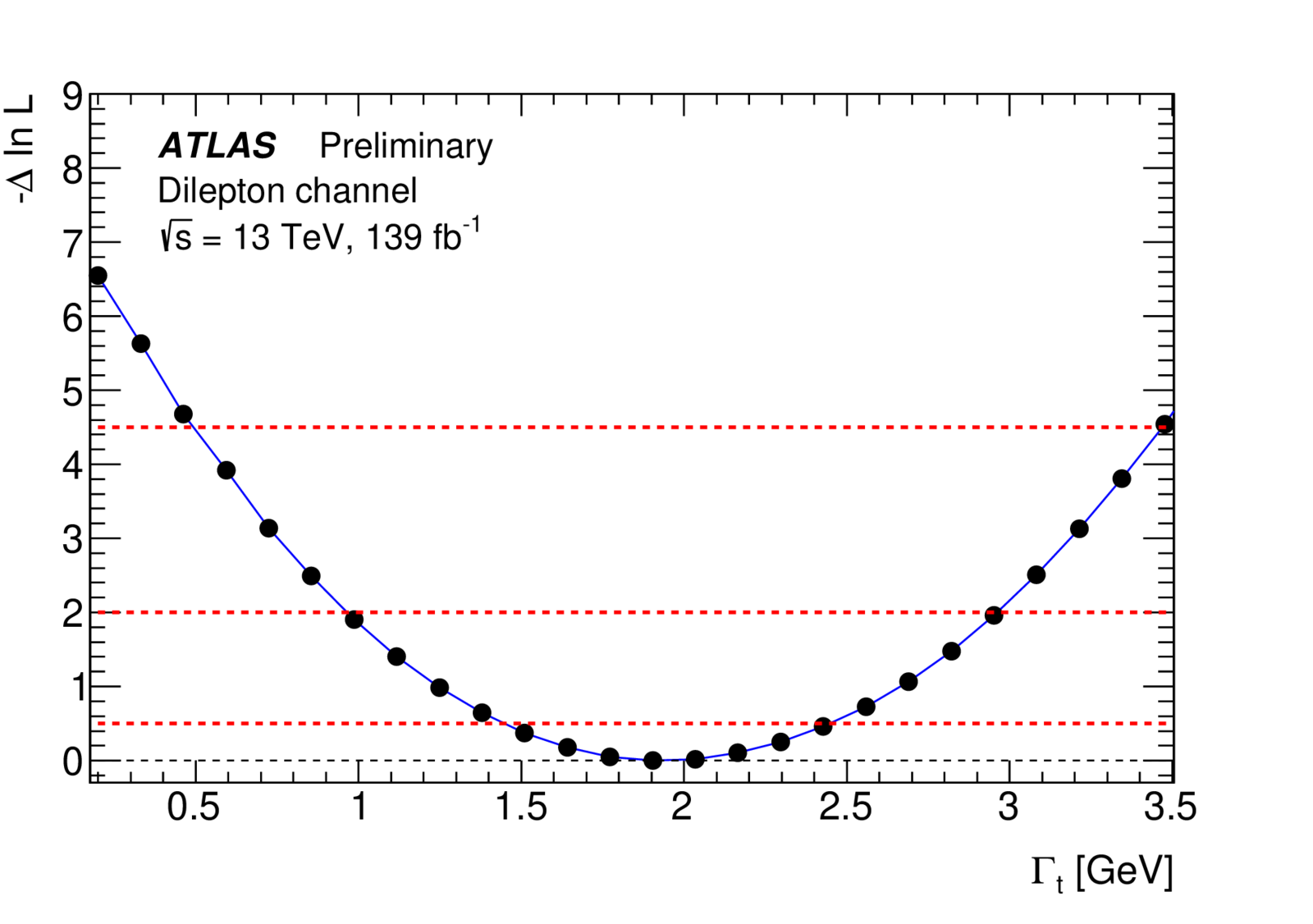
One of the fundamental properties of an elementary particle is its mean lifetime (average time the particle exists until it decays to lighter particles). Although the mean lifetime is intuitively easy to understand, a theoretically more interesting variable is the inverse of mean lifetime (in natural units with reduced Planck constant equal to 1). This variable is called decay width, Γ. Decay width is not a fundamental parameter of the Standard Model, it can be calculated assuming we know the particle mass. Standard Model predicts the value of the top quark decay width as Γ = 1.33 GeV.
Our team was involved in the direct measurement of the top quark decay width. The obtained results are compared with the theoretical prediction in the following publications:
- Analysis of 8 TeV data: Eur. Phys. J. C(2018) 78:129 (arXiv:1709.04207),
- Analysis of 13 TeV data: conf. note: ATLAS-CONF-2019-038.